The Alpine Alpenglow concept, a Le Mans-inspired hydrogen powered hypercar, combines the Renault brand’s aspirations for both racing and road cars as it prepares to launch three new full-electric models.
The Alpenglow will make its debut at the Paris auto show on Monday. Alpine is also showing the A110 R, a lightweight version of the sports coupe, as well as the A110 E-ternity, a full-electric concept version that was unveiled in 2021.
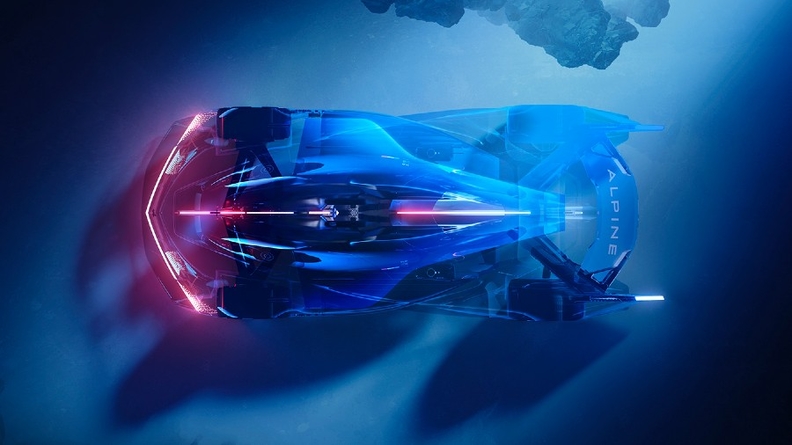
The five-meter-long (16 feet) Alpenglow takes its proportions from Le Mans and Formula One race cars, with a single-seat central cockpit nestled between two 700-bar hydrogen tanks. It is less than one meter high.
The concept’s design “hints at what Alpine cars will be like tomorrow, and at our vision for motor sports moving forward,” brand CEO Laurent Rossi said in a news release Thursday.
Alpine’s future LMDh-category racing cars will draw on the Alpenglow’s silhouette. The category, which stands for “Le Mans Daytona hypercar,” is a semi-spec sports-racing series that will start in 2023 for both the WEC and IMSA.
Alpine plans to enter a WED vehicle in 2024. Entrants can choose from among four chassis, but must use a spec hybrid system; body and engine choice are less restricted.
Extended wings on the rear fenders make reference to the A220 streamliner racing cars of the late 1960s.
Alpine, which started in the mid-1950s as an independent Renault tuner and small-volume manufacturer, was acquired by Renault in the early 1970s. The brand was dormant during the 1990s and 2000s, but was revived under former Renault CEO Carlos Ghosn in 2017, with the A110, a mid-rear-engine sports coupe that evoked the original model.
The current A110 is powered by a turbocharged 1.8-liter gasoline engine and is set to be replaced by a full-electric model co-developed with Lotus. Two other production EVs are planned by 2025: A small hot hatch expected to be related to the coming Renault 5, and a compact crossover called the GT.
Renault CEO Luca de Meo is also branding high-trim versions of Renault cars as Alpine, with the Austral compact crossover the first to use the designation.
Alpine describes the concept as embodying the brand’s “reboot,” with an equal emphasis on racing, road cars and sustainability. The sleek, flowing design was inspired by natural elements such as fire, water, air and ice, creating “an agile and elegant car that is just as comfortable on roads as it is on tracks.”

The Alpenglow’s partly transparent body, made of recycled carbon fiber, is based on two interlocking triangles that meet at the cockpit.
The partly transparent body, made of recycled carbon fiber, is based on two interlocking triangles that meet at the cockpit. Extended wings on the rear fenders make reference to the A220 streamliner racing cars of the late 1960s.
Alpenglow’s cockpit is based around a racing-style steering wheel, with buttons and selectors for functions such as regenerative braking and “push to pass” overboost.
The concept’s powertrain is described as a hybrid hydrogen internal-combustion engine, a technology that has been promoted as a way to extend the life of combustion engines with near-zero emissions. Alpine says it is drawing on the expertise of Hyvia, Renault Group’s hydrogen unit, to develop such as system, for potential use in road and racing cars.