 Hani Joudi
- All-new, all-electric mid-size SUV, the first model in Toyota’s new bZ – Beyond Zero – range of battery electric vehicles
- First model to feature eTNGA philosophy, which integrates the battery unit into the vehicle’s structure, giving extra rigidity and a low centre of gravity for rewarding driving dynamics
- eTNGA is a modular architecture that can be easily adapted for different vehicle sizes and types
- Available in front and all-wheel drive versions
- bZ4X brings class-leading off-road capability to the BEV market with optional all-wheel drive system
- Driving range of up to 516 km for FWD model, 470 km with AWD

The bZ4X is Toyota’s first all-new battery electric vehicle (BEV). It breaks new ground in launching the company’s bZ “Beyond Zero” sub-brand of zero emission models and in bringing genuine SUV off-road driving capability to the BEV market for the first time. Its introduction will accelerate Toyota’s multi-technology path towards its goal of carbon neutrality.

The bZ4X’s quality and performance are founded on Toyota’s world-leading experience in electrified vehicle technology, a heritage that spans more than a quarter of a century. The company has also worked with Subaru as its development partner for bZ4X, benefiting from the manufacturer’s renowned expertise in areas such as all-wheel drive engineering.

The bZ4X is not an adaptation of an existing model. Instead, it is wholly original and the first of what will be a series of different bZ vehicles to be constructed on a new Toyota platform dedicated to BEVs. eTNGA integrates the battery unit into the chassis, entirely beneath the vehicle floor. The result is a strong and highly rigid framework and a low centre of gravity, defining factors in the bZ4X’s stable and rewarding dynamic performance. The modular design allows it to be easily adapted for use in a wide range of different vehicle types, spanning from small to larger segments.

The bZ4X is available in both front and all-wheel drive versions. The FWD model features a 150-kW front-mounted eAxle that produces 204 DIN hp and 265 Nm maximum torque. The AWD model, uses front and rear 80 kW eAxles with a combined output of up to 218 DIN hp and 337 Nm of torque. Class-leading off-road performance is enabled by the AWD system, with X-MODE to give secure and stable performance through mud and snow.

The lithium-ion battery unit has a 71.4 kWh capacity and comprises 96 cells which are water-cooled and constantly monitored individually for any signs of abnormality or degradation.

Toyota’s confidence in the quality of the battery is reflected in a guarantee it will retain at least 70 per cent of its capacity up to 10 years, covered by the original EV Manufacturing Warranty until 8 years or 160.000 kilometres, and with the additional Extended Battery Care up to 10 years or 1 million kilometres driven that is activated by an annual EV Health Check (T&C apply).

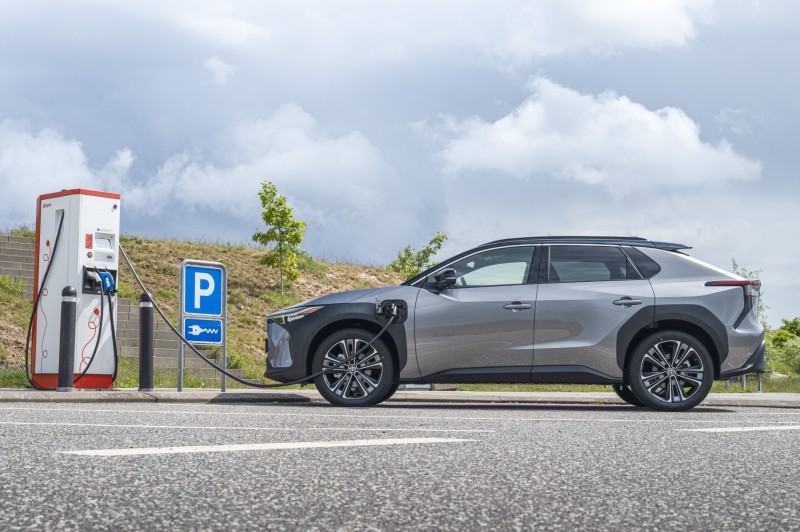
The bZ4X has an official driving range (WLTP standard) of up to 516 km for the FWD version and up to 470 km for the AWD model. Fast-charging to 80% capacity can be accomplished in around 30 minutes, in normal temperature conditions. At launch, the vehicle has a 6.6 kW on-board charger. Cars being produced towards the end of 2022 will be built with an 11 kW unit for faster charging performance.

Toyota’s multi-tech route to zero carbon
Toyota is a “full line-up” manufacturer of vehicles that can help everyone reduce their carbon footprint in all parts of the world.

This includes hybrid electric, plug-in hybrid electric, fuel cell electric and battery electric vehicles – the latter range set to grow with the roll-out of new bZ “Beyond Zero” models, starting with the bZ4X SUV. Toyota calls this multi-tech approach “the power of and.”
Since the introduction of the original Prius in 1997, the company has put more than 20 million electrified vehicles on the road. Throughout, it has recognised that environmentally efficient vehicles can only be effective through widespread use: they must be accessible and desirable for customers, meeting their mobility needs.

As the pace of electrification accelerates, Toyota expects to sell 5.5 million electrified vehicles a year worldwide by 2025, with a line-up of 70 models, including 15 zero emission vehicles.
In Europe, its forecast is for 90% of its Western European sales to be electrified vehicles by 2025, of which at least 10% will be ZEVs. This figure will increase to 100% electrified by the end of the decade, with at least 50% ZEVs (a greater proportion if market demand and infrastructure development permit). And by 2035 the target is a full 100% reduction in new vehicle CO2 emissions – potentially earlier in some individual national markets.

This ambition was voiced by Matt Harrison, President and CEO Toyota Motor Europe (TME) at Toyota’s Kenshiki (“insight”) media event in December 2021. He said: “Moving beyond 2030, we expect to see further ZEV demand acceleration and Toyota will be ready to achieve 100% CO2 reduction in all new vehicles by 2035 in Western Europe, assuming that sufficient electric charging and hydrogen refuelling infrastructures are in place by then, together with the renewable energy capacity increases that will be required”
DESIGN AND LIFE ON BOARD
- Exterior design explores the styling freedoms offered by a battery electric vehicle
- “Hi-Tech and Emotion” design theme blends advanced BEV looks with original SUV qualities
- Frontal design presents new signature Toyota BEV “hammerhead” shape
- Cabin design and lay-out evokes the comfort and space of a living room

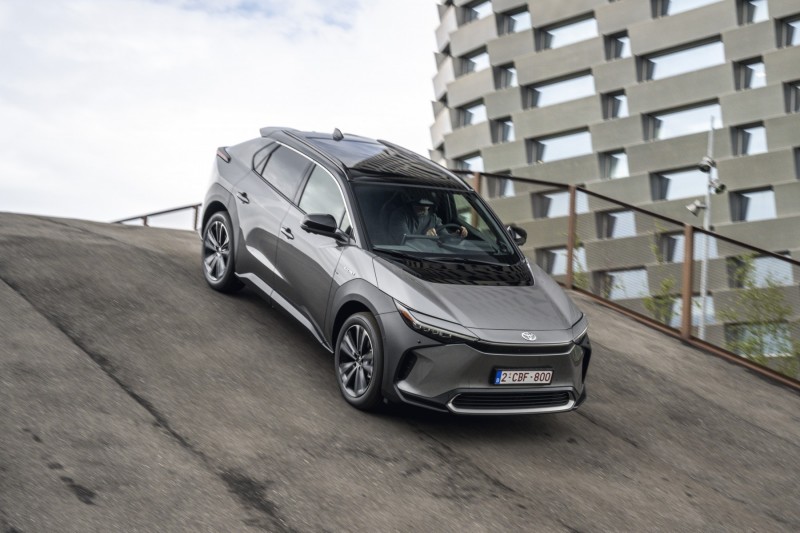
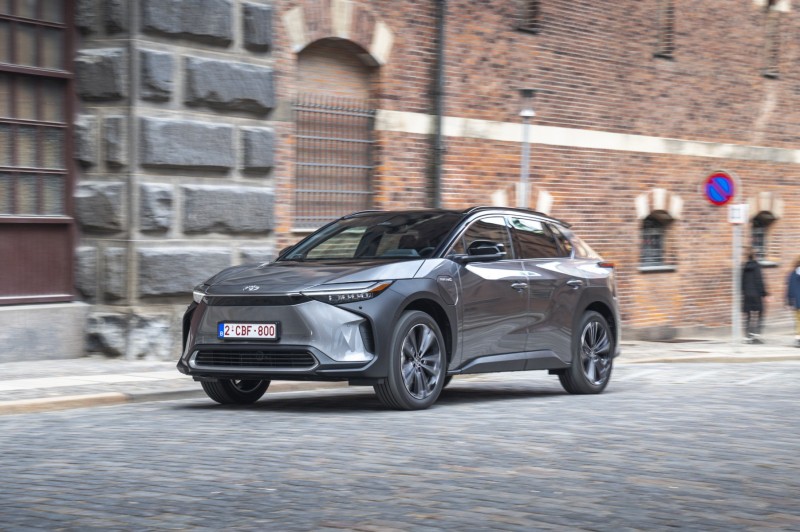
Toyota has produced a sleek and robust design for the bZ4X that’s equally appropriate for modern urban life and the countryside, blending the advanced look of a BEV with the original qualities of an SUV. The theme for the design team was “Hi-Tech and Emotion,” challenging conventions while meeting customer expectations with an advanced feel and high-quality surfaces.

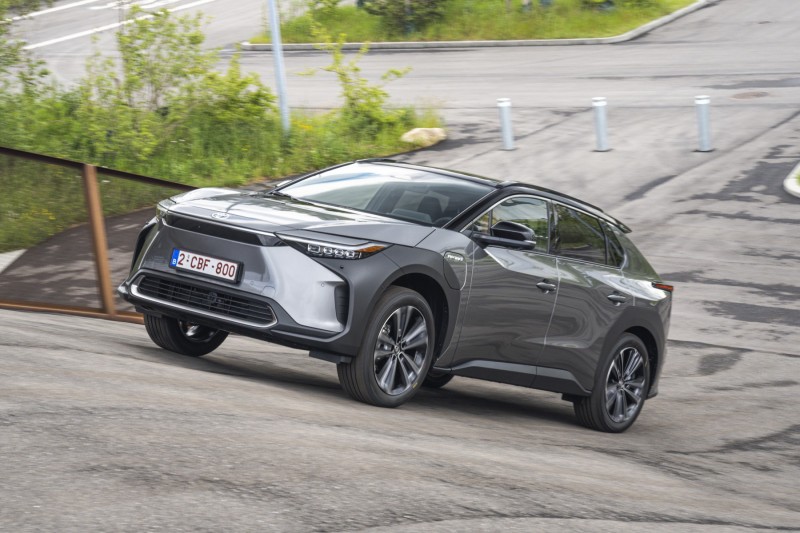
The frontal appearance is smart and avoids unnecessary decoration. It is characterised by a new brand-defining “hammerhead” shape with signature slim LED headlight units and an emphasis on the front corners that communicates the car’s strong stance.

In side view, the silhouette is sleek with a low overall height, slender front pillars and a low axis line that reflects the low centre of gravity achieved with the new platform and its low-set, integrated battery unit. Wheel arch mouldings, large wheels (up to 20-inch diameter) pushed out to the corners of the body and thick rocker panels express the car’s authentic SUV character. At the rear, the design focus is again on emphasising the corners, with a distinctive taillight bridging the width of the vehicle.
Compared to the Toyota RAV4, the bZ4X has an overall height that’s lower by 85 mm, shorter overhangs and a wheelbase that that’s 160 mm longer. The bonnet line is also reduced in height by 50 mm. Overall agility is reflected in a class-leading 5.7 m turning radius.

The design incorporates aerodynamic elements that contribute to the generous driving range, including apertures set deep in the front bumper corners to create smooth air curtains; a full underbody cover; a split roof spoiler and (optional) rear duck-tail lip spoiler; rear diffuser; and a precisely angled rear screen. The slim lower grille has a shutter that adjusts to channel cooling air flow to the battery and helps reduce wind resistance.

To reduce intrusive noise, thicker glass is used in the side windows and there is a wider, uniform gap between the door mirror and front three-quarter panel, reducing the sound produced by wind turbulence.
The bZ4X is available in six monotone colours, including new Precious Metal and Precious Silver, plus five bi-tone finishes that combine coloured bodywork with a contrasting black roof and pillars.

Design – interior
The theme for the interior is comfort and spaciousness that give the cabin the ambience of a living room, a sense that’s enhanced by the use of soft, woven trim textures on the dashboard, satin-finish detailing and the option of a panoramic roof.
The instrument panel is slim and low set, adding to the sense of openness and the driver’s forward visibility. This design has been made possible thanks to the use of a new air conditioning unit that is 30% more compact.

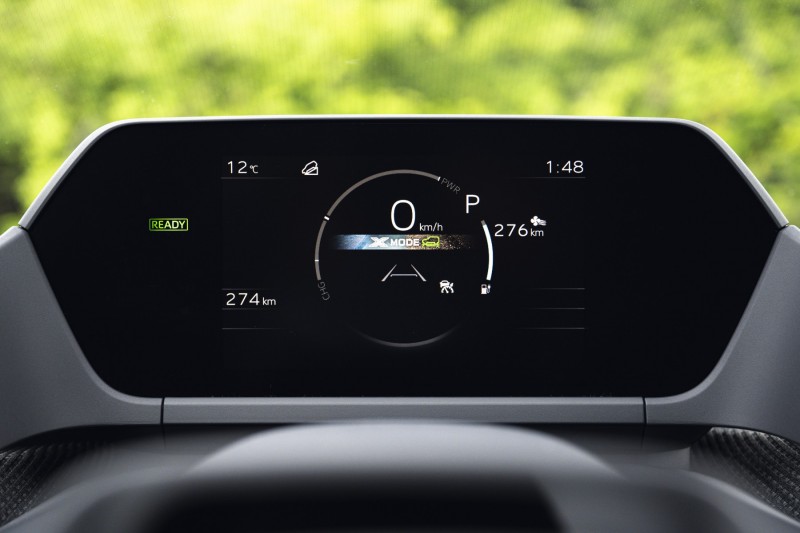
The “hands on the wheel, eyes on the road” principle is supported by the human-centred cockpit in which the seven-inch TFT instrument and information display sits directly in the driver’s forward eyeline, top-mounted above the line of the steering wheel, so the meters can be viewed with minimal eye movement.
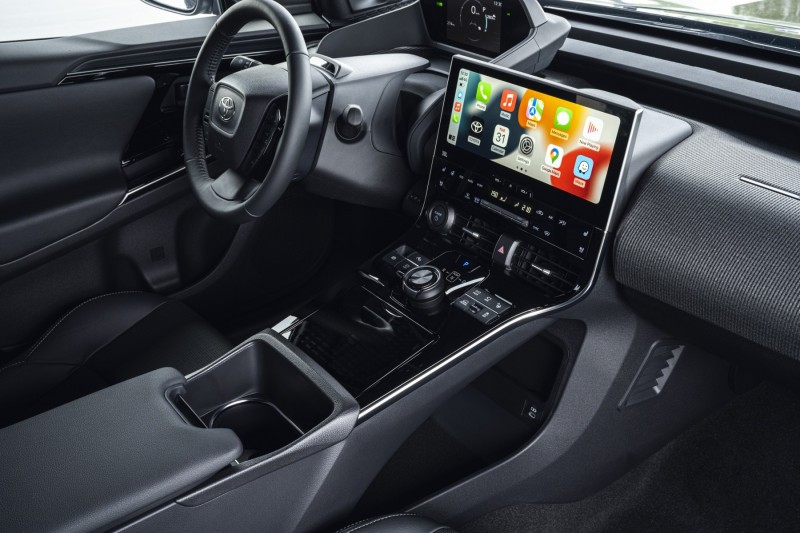
The centre console is the focus of the “social” quality of the cabin design, accessible for everyone on board and offering a total of 20 litres of storage space. This includes an open area beneath the console, suitable for a pair of shoes or handbag, and individual spaces to carry everything from a smartphone to a tablet and large bottle. In a neat touch, the smartphone cubby has a transparent lid so you can see at a glance if you have received an alert.
According to the multimedia system specified, the bZ4X has an 8 or 12.3-inch touch screen display. The large display is used for the latest Toyota Smart Connect system, with advanced functions and improved voice recognition control to access information and entertainment and to operate a number of vehicle functions, such as the air conditioning and windows.
The driver’s multimedia options include useful connected services that can be accessed using the Toyota MyT app. Of particular value to drivers of the bZ4X and other Toyota BEVs is the access it can provide to one of the world’s largest network of charging points. Contributing to Toyota’s “Kanzen” approach to giving owners complete peace of mind, customers can sign up to the service, choose their preferred tariff and use the app to find available charging stations nearby and make automatic payments. The status of individual charging points can also be checked using the app.

Other current MyT functions include “find my car,” which retrieves the vehicle’s location and can provide details on a map, together with navigation directions if required. “Share to Car” allows for journeys to be planned and then sent to the car’s navigation system, while “Car to Door” gives directions for the last part of a journey after the vehicle has been parked. Driving analytics, service reminders, the level of battery charge and remote activation of the hazard lights are also available through the app.
The car can be locked and unlocked remotely and you can check the car’s status – whether windows or roof are open, the doors unlocked, the lights on or the key left inside the vehicle.
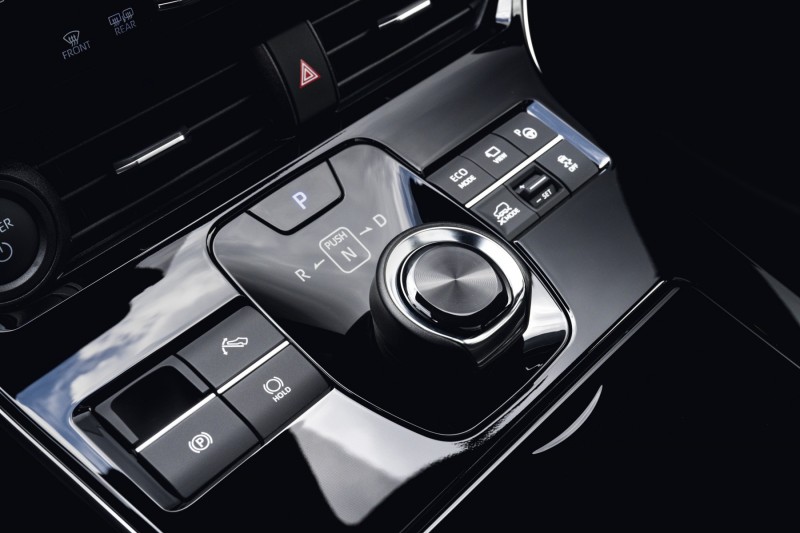
Instead of a conventional shift lever, the bZ4X has a new dial control: the outer section is depressed and turned to the left or right to select drive or reverse. The P (Park) setting is a one-touch button immediately behind the dial control.
LED cabin lighting is featured in the front footwells, centre console, door panels and door handles and the load space. On higher grade models, rear footwell lighting is provided, the driver’s seat is power-adjustable and both front seats have integrated heating and ventilation. Upholstery options are perforated leather or synthetic leather; synthetic leather with fabric; or all-fabric. Colour-way choices are black-on-black or a combination of light grey and black.
Battery technology
The high-density lithium-ion battery comprises 96 cells and has a 355.2 voltage rating. Its gross capacity is 71.4 kWh and it has an ambient temperature operating range of between -30 and +60°C.
Key to the battery’s quality and durability is multiple monitoring of the voltage, current and temperature, from individual cell level. If any abnormal heat generation is detected, controls are automatically triggered. Countermeasures have been put place to mitigate any material degradation, and there are safeguards in the manufacturing process to prevent foreign matter from entering the battery.
This is the first battery in a Toyota vehicle to adopt a water cooling system. This uses a refrigerant and helps maintain stable output with each cell individually cooled. The system is linked to the vehicle’s air conditioning system so there is power-efficient co-ordination of battery and cabin temperature control.
Thanks to an efficient and effective heating system, including a heat pump, reliability is also maintained in sub-zero temperatures.
Toyota’s confidence in the quality of the battery is reflected in a guarantee it will retain at least 70 per cent of its capacity up to 10 years, covered by the original EV Manufacturing Warranty until 8 years or 160.000 kilometres, and with the additional Extended Battery Care up to 10 years or 1 million kilometres driven that is activated by an annual EV Health Check (T&C apply).
Battery charging and driving range
European versions of the bZ4X use a battery suitable for reliable charging in very low temperatures. The battery can be fast-charged without compromising safety or service life: an 80% charge can be achieved in around 30 minutes with a 150 kW fast-charging system (CCS2); a full charge using a 230 V/32 A supply will take around 9.5 hours. From Q4 2022, an 11 kW three-phase on-board charger will replace the initial 6.6 kW unit.
The bZ4X’s official WLTP performance data confirms the vehicle will deliver a generous driving range. The front-wheel drive model will achieve up to 516 km on a fully charge battery, with an efficiency rating of 143.2 Wh/km (7 km/kW); the all-wheel drive version has an official range of up to 470 km with 158 Wh/km (6.3 km/kW) efficiency.
About the Author